Short answer: a daruma tattoo stands for perseverance and reaching your goals. The round, weighted doll always rolls back upright when knocked over, which is why it’s linked to the Japanese saying “fall seven times, get up eight”. The doll is sold with blank eyes. You fill in one eye when you set a goal and the second when you achieve it. So a tattoo with one eye filled means a goal in progress, and two eyes means a goal reached. The doll is modeled on Bodhidharma, the monk credited with founding Zen Buddhism.
The daruma is one of the friendliest Japanese tattoo subjects: simple, bold and full of meaning. Here’s the story behind it and how the details change what it says.
The monk behind the doll
Daruma is the Japanese name for Bodhidharma, a 5th–6th century monk traditionally credited with bringing Zen (Chan) Buddhism to China. According to legend, he meditated facing a wall for nine years, so long that his arms and legs withered away. That’s why the doll is a round body with a face and no limbs. His fierce eyebrows and beard come from the same image of a stern, determined monk.
Fall seven times, get up eight
Daruma dolls are made of papier-mâché, hollow and weighted at the bottom. Push one over and it rolls back upright. That’s the heart of the symbol, summed up in the saying nanakorobi yaoki (七転び八起き): “fall seven times, get up eight”. It’s about resilience: not avoiding failure, but getting back up every time.
The eye ritual
New daruma are sold with blank white eyes.
- When you set a goal, you paint in one eye. Many people start with the left one.
- The doll then sits somewhere you see it every day, half-blind, as a reminder.
- When the goal is achieved, you paint in the second eye.
At the end of the year, many people take their old daruma back to a temple, where they’re burned in a ceremony, and buy a new one.
In a tattoo, this gives you a real choice:
- One eye filled: a goal you’re still working towards, or a reminder to keep going.
- Both eyes filled: something you achieved, recovered from or completed.
- Both eyes blank: less common, and can read as unfinished. Worth deciding on purpose.
Colors and details
- Red is the traditional color. In Japan red was long associated with warding off illness, and it’s also the color of Buddhist monks’ robes in many images.
- Other colors (gold, white, black, green and more) are sold today with assigned meanings such as money, love or health. These are mostly modern and vary by seller, so treat them as a personal choice.
- The face: on many daruma from Takasaki, the town most famous for making them, the eyebrows are shaped like a crane and the beard like a tortoise, both symbols of long life.
- The belly: often carries a kanji such as 福 (luck), 必勝 (certain victory) or 七転八起. Have any kanji checked before the session; see our kanji accuracy guide.
What a daruma tattoo can mean
- Perseverance after setbacks, illness or a hard period.
- A goal, either one you’re chasing (one eye) or one you’ve reached (two eyes).
- Good luck, as daruma are also lucky charms.
- Zen roots: patience, focus and discipline.
Design ideas
- Classic red daruma with bold outlines, alone or with cherry blossoms, waves or wind bars.
- Black and grey daruma, softer and more like a statue.
- Paired with other lucky figures, such as the maneki-neko beckoning cat; see our cat tattoo guide.
- Cracked or broken daruma, sometimes used to show survival or a hard-won recovery.
Size and placement
A daruma’s simple, round shape is one of the few Japanese subjects that holds up well small. A palm-sized piece on the forearm, calf, upper arm or ankle reads clearly. It also works as a filler between larger elements in a sleeve. Keep the eyes and the face bold so the expression stays readable as the tattoo ages; our small tattoo symbols guide covers sizing for small pieces.
At GOAT Tattoo Studio
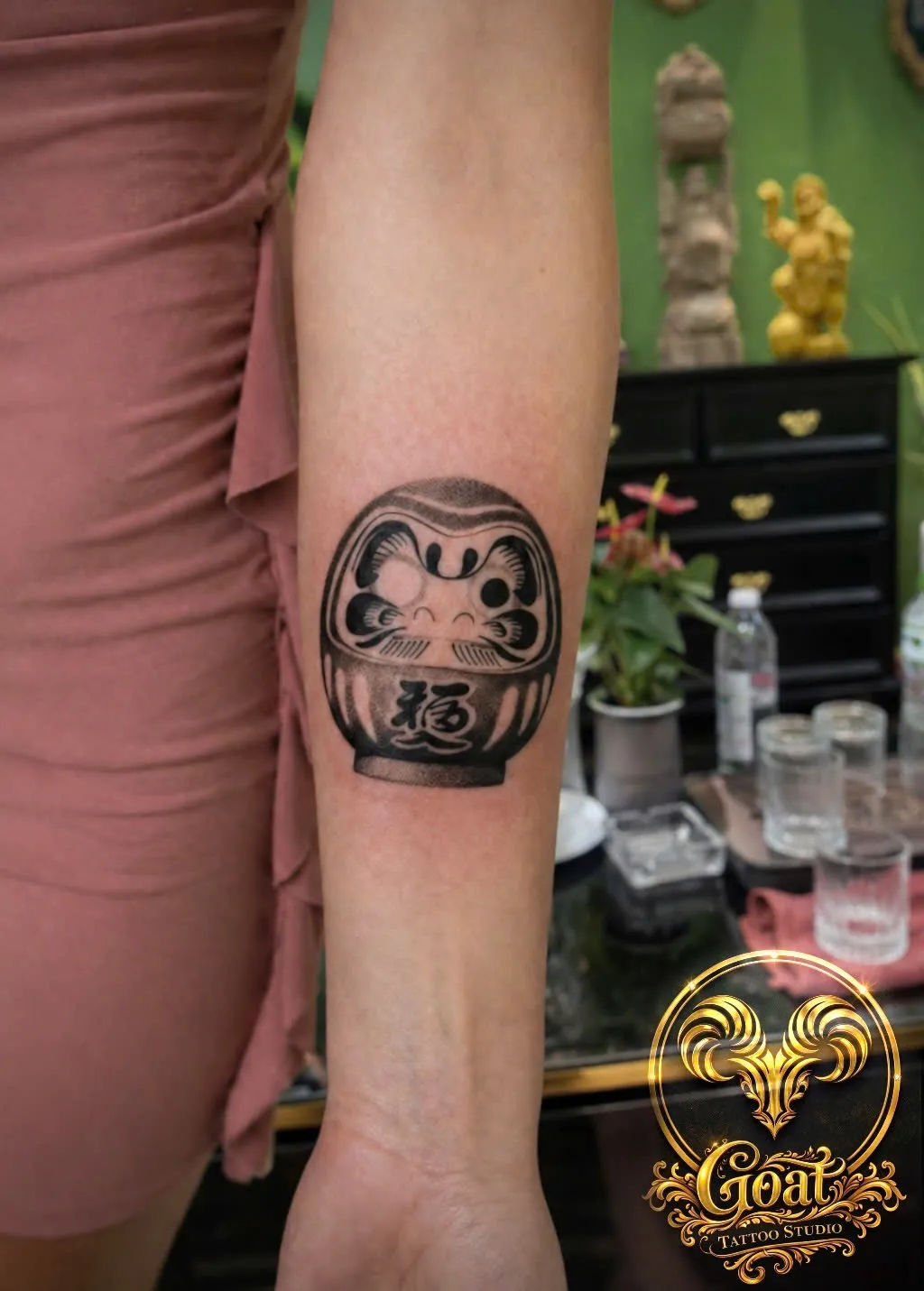
Our gallery includes a black and grey daruma on the forearm done at the studio. At your consultation we can help you decide on one eye or two, the color and any kanji, so the daruma says exactly what you want. Our Japanese motifs guide covers other traditional subjects.
Planning a Japanese tattoo in Hanoi? Our Japanese tattoo page has prices, the artists who do this style and recent work.

View more
Nautical Star Tattoo Meaning
Swallow Tattoo Meaning: The Real Sailor Tradition Behind It
How to Find Tattoo Design Ideas Before You Book in Hanoi
Popular Small Tattoo Symbols and What They Actually Mean
Japanese Tattoo Motifs and What They Actually Mean
Daruma Tattoo Meaning: One Eye, Two Eyes and Getting Back Up
Sugar Skull Tattoo Meaning: Día de los Muertos vs. Memento Mori
Family Tattoo Symbols: Meanings and Ideas That Last